
by Neville Teller
 Professor Flora Cassen is a Belgian-born historian. Specializing in European Jewish history, her recent work has expanded into the analysis of contemporary antisemitism. In her new book, Stained Glass, she traces the history of Jew hatred in Europe across the centuries. She does so in a most unusual and agreeable way. She sets her insightful and comprehensive account within the context of a personal memoir – her own journey from Europe to the United States, and the perspective it has provided for her.
She recounts her family’s experiences during the Second World War, including her grandmother’s escape from Nazi-occupied Antwerp and subsequent exile in the Belgian Congo, and reflects also on her own childhood in Jewish schools in Europe, where security concerns were a routine part of daily life.
She takes as her starting point the medieval Cathedral of St Michael and St Gudula that stands in the center of Brussels. She tells us that when she was a college student, she loved strolling past it at night, finding its lace-like stonework stunning. Then she reveals what she calls “a disturbing truth”.
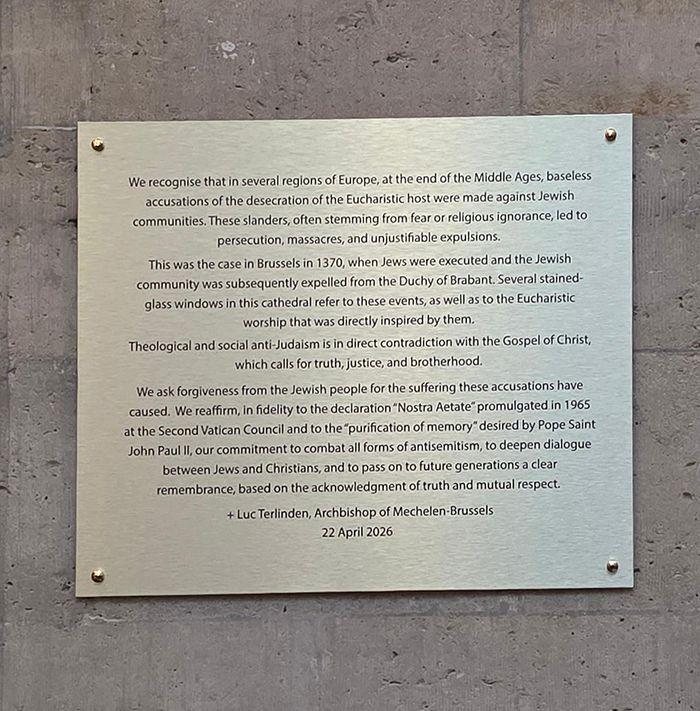
“The gorgeous stained-glass windows,” she writes, “are almost entirely devoted to the false accusation that, in 1370, Jews stole and desecrated the holy hosts” – that is, the consecrated wafers that represent the body of Christ during the communion element in Christian worship.
“The large windows,” she continues, “depict Jews torturing and stabbing the wafers.” In the trial that followed, some witnesses testified that, when stabbed, blood flowed from the wafers.
Cassen writes that in the 1960s Belgian Jews asked the Church to acknowledge that the whole episode had been nothing more than a traditional anti-Jewish libel. Cardinal Suenens, then head of the Belgian church, arranged for a number of scholars to investigate the case.
Based on the medieval trial records, Cassen tells us, “These scholars wrote that there was insufficient evidence to determine that the accused Jews had been innocent.” They ignored, she points out, that there was equally scant evidence that they were guilty.
As a result, a couple of plaques were placed in obscure places in the cathedral, worded equivocally to imply that the story of the stolen and desecrated wafers might be biased.
Cassen draws a direct connection between age-old tropes like this, rooted in the Middle Ages, and antisemitism in current Western society. Jews, she points out, are still perceived as alien and threatening, both powerful and weak, both insiders and outsiders. “In today’s conspiracy-saturated world,” she writes, “Jews and Israel often appear at the center of elaborate plots reminiscent of the medieval fantasies that depicted Jews as spreading disease, killing children, or secretly controlling the world.”
Cassen makes an excellent point in relation to pre-modern times when she distinguishes between antisemitism and anti-Judaism. Antisemitism, she points out, “refers to racial hatred of Jews; anti-Judaism is a hatred of Jews based on religion.”
For an antisemite there is no “cure” for Jewishness – Jews are of a different racial nature and therefore unchangeable. On the other hand, anti-Judaism, she says, “posits that Jews are changeable; they can convert to Christianity and cease to be Jewish.”
The distinction was more meaningful when religion was a major element in society – perhaps in the period up to the first World War in 1914. The current fashion in Western society is to uphold the rights of minorities, including Jewish communities, but to tolerate much anti-Jewish, anti-Zionist, and anti-Israel sentiment, while allowing those propagating it to deny that the result is antisemitism.
In her chapter “Teaching about hate”, Cassen tackles another complex and deep-rooted problem. In her seminars on antisemitism Cassen had been emphasizing the need to understand the thinking that motivated prominent anti-Jewish proponents, and the reasons and justifications they had developed to support it.
“What I had failed to recognize,” she writes, “was that by insisting we needed to understand antisemitic thinkers and ideas, I had contradicted the notion that antisemitism is a heap of irrational falsehoods.”
When one of her students pointed out the anomaly, Cassen acknowledged the issue. Her role, she told herself, was not just instructing her students in the history of antisemitism. It was also helping them, and herself, confront that part of ourselves that can understand hate. “For once we do it,” she writes, “we can also reject that hatred…by explaining how and why it is wrong.” Then she tells us: “I carry my student’s lesson in this book.”
It was clearly her academic work on antisemitism that motivated her to start writing her book but, she tells us, it “soon took on a life of its own, weaving together memory, family stories and history.” Through the filter of personal experience, Cassen demonstrates that Europe as a whole – with, perhaps, the exception of Germany – has never fully confronted the anti-Jewish prejudices ingrained in its cultural consciousness. It continues to struggle with the legacy of anti-Jewish sentiment embedded in its social and cultural traditions.
In “Stained Glass” Flora Cassen has produced an exploration of antisemitism that is both unique and a most pleasurable read, replete with photographs and illustrations. It is highly recommended.
Neville Teller MBE is a British dramatist and abridger. A prolific contributor to BBC Radio, his work includes some 50 radio dramatizations and well over 250 abridgements for radio readings. His reviews have appeared in The Jerusalem Post, Eurasia Review, and elsewhere.
