
By Rivkah Lambert Adler
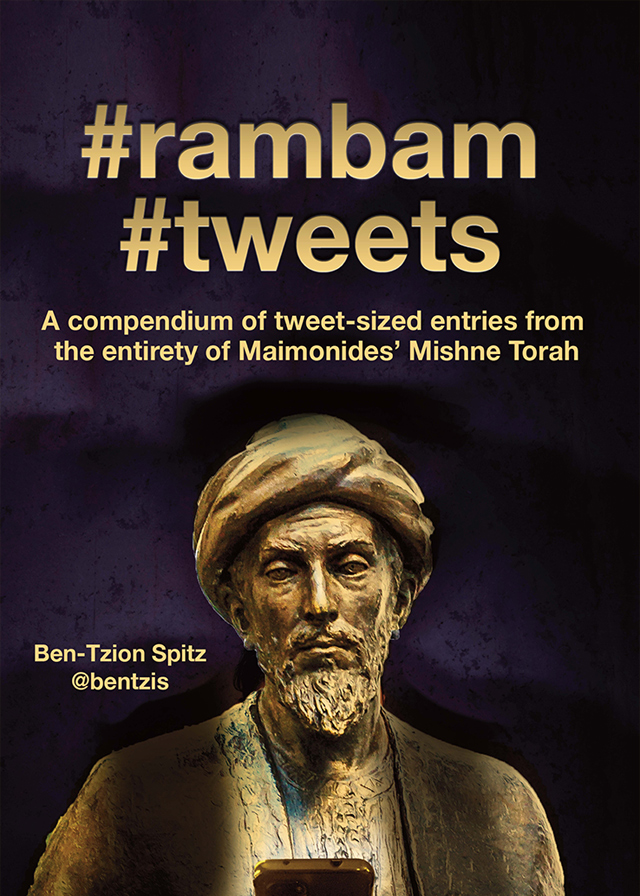
In an age defined by shrinking attention spans and endless digital noise, Rabbi Ben‑Tzion Spitz is quietly demonstrating that depth and brevity need not be enemies. His work #Rambam #Tweets embodies a distinctive approach to Torah dissemination: radical compression of Torah ideas without dilution and reverence for tradition expressed through modern tools.
Rabbi Spitz’s worldly sensibility did not emerge by accident. Born in Queens and raised in Venezuela and Brazil, he grew up in a family whose business spanned continents and cultures. Jewish day schools anchored his identity, while exposure to multiple cultures expanded his worldview. He speaks four languages fluently: English, Hebrew, Spanish and Portuguese.
Spitz returned to the US in 10th grade and graduated from Yeshiva University High School for Boys. He studied at Kerem B’Yavneh in Israel, then returned to the United States to complete both a bachelor’s degree from YU and a master’s degree in mechanical engineering from Columbia University. He made aliyah with his wife and two children in 1997.
Rabbinic ordination came later, after years spent working in the intersection of business and technology. Spitz experienced a significant career detour when he served as the Chief Rabbi of Uruguay. When he returned to Israel in 2016, he was searching for a framework for personal learning that could also be shared with others. The idea itself was not new; he had been thinking about it for years, but time and circumstance finally aligned. The challenge he set for himself was deceptively simple: could a meaningful Torah idea be conveyed in 140 characters or fewer?
Twitter (now X) provided both the constraint and the catalyst. In 2016, Twitter limited users to messages of no more than 140 characters. Rabbi Spitz began producing “tweet-sized” Torah entries aligned with established daily learning cycles: Rambam Yomi, Daf Yomi, Mishnah Yomi, Halacha Yomi, Tanya Yomi, Emunah Yomi, and weekly parashah insights. Each entry distilled a single idea from a single source, one day at a time. He was not creating new Torah content. Instead, he was compressing existing texts into a 140-character framework.
So far, he’s taken one of these social media projects and published it under the title #Rambam #Tweets. It’s a compendium of the daily tweets he wrote, covering all 1,000 chapters of Maimonides’ Mishneh Torah, synchronized with the three-year Rambam Yomi cycle. The result is an innovative, eclectic yet profoundly respectful engagement with one of Judaism’s most foundational legal works.
The inspiration, Rabbi Spitz explains, came from Chok L’Yisrael, short, daily learning units, particularly popular in Sephardi communities, that allow a learner to review many areas of Torah in just 10–15 minutes. His Twitter project was a condensed version of that model, adapted for modern life and modern platforms. Soldiers with limited free time, professionals juggling demanding schedules and learners seeking breadth rather than depth all found value in the format. At its height, several hundred people followed the tweets daily.
Eventually, the Rambam material demanded a more permanent home. Twitter is fleeting by design; Mishneh Torah is not. Compiling the tweets into a book transformed an ephemeral learning experience into a durable reference. The book functions both as a rapid review tool for those who have already learned Rambam and as a surprisingly accessible gateway for those who never have. “In a few hours, you can have a sense of the entirety of what the Rambam’s Mishneh Torah accomplishes,” he asserted. “It goes a level deeper than a table of contents, without being overwhelming.”
The challenge he set for himself was deceptively simple: could a meaningful Torah idea be conveyed in 140 characters or fewer?
This philosophy of distributing Torah in new ways animates his other writing. Rabbi Spitz is the author of 13 books, including a substantial body of biblical fiction. He has written about each of the Five Books of Moses as well as a novel based on Yehoshua. Currently, he’s working on a novel based on the life of Ehud ben Gera whose story is told in the Book of Judges. Spitz reported that he does “an insane amount of research,” for his biblical fiction, drawing on every relevant midrash as well as on-site archaeological exploration to be able to convey a sense of place.
His biblical fiction remains loyal to Chazal’s understanding, while assuming readers have little to no background. “Lord of the Rings meets the Bible,” he quipped, but with a serious purpose. In a world where children can name every sibling of Harry Potter’s best friend Ron Weasley, but not the twelve tribes of Israel, biblical fiction becomes a tool of cultural continuity.
Whether through tweets or novels, Rabbi Ben-Tzion Spitz is guided by a consistent principle. “I’m pursuing the distribution of Torah in new ways. If someone has already done it, I don’t need to retread that path,” he shared.
Torah is eternal, but the ways we encounter it need not be static. Spitz’s work reminds us that even within the tightest of spaces, 140 characters, there is room to learn something deep.