
By Howard Jay Meyer
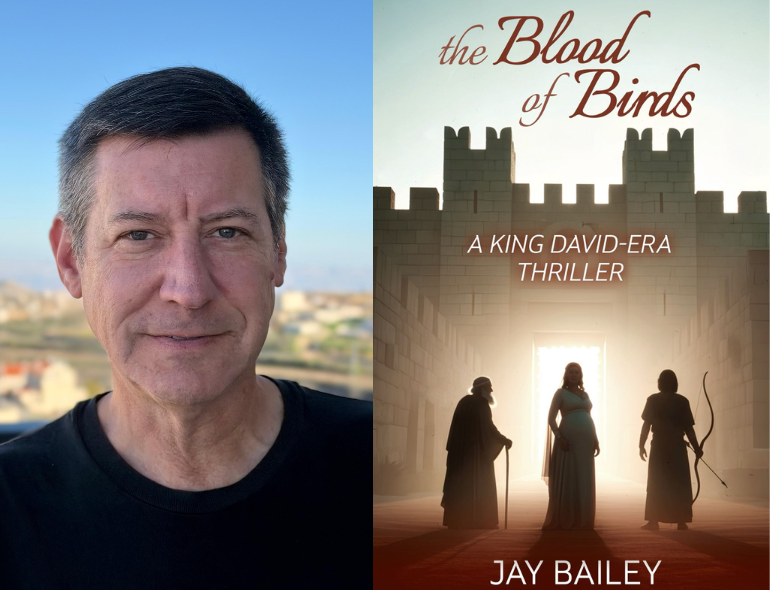
The Blood of the Birds: A King David Era Thriller takes us into a city of refuge in Israel just as King David’s reign is ascending. In his foresight and love for the Jewish people, Moses established these cities well before the Jews entered the Land of Israel (even though he did not enter the Land himself). While the rules of the accidental killer are outlined in Sefer Devarim (Book of Deuteronomy), there is a leap of 1,000 years to the Mishna where those rules are delineated. And yet, there is no actual evidence that an ‘Ir Miklat’ (city of refuge) ever existed. Indeed, Jewish historian and podcaster Rabbi Dovid Katz does not know of a case where anyone actually went to a city of refuge. Thus, the intrigue and room for creative rumination.
In his debut novel, Jay Bailey expertly fills this gap with a fictional account of how the story of an accidental killer and the family of the victim seeking vengeance may have unfolded. Bailey deftly combines his imagination with historical accuracy to bring us a compelling story. Here, there is a “delicate dance” between delivering a historical work of fiction and giving the reader accurate historical context, says the author. And Bailey certainly delivers.
According to the Torah, if someone kills a person by accident, the victim’s family could avenge their relative’s blood by killing the accidental killer unless he made it to a city of refuge (Ir Miklat in Hebrew). Once there, the killer’s case would be adjudicated to see if he really did kill accidentally. If it was found that he did kill intentionally, he would be refused entry (therefore allowing the blood avengers to pursue him). If the death was deemed an accident, the city would allow the killer to enter, thereby affording him protection from the blood avengers. Once the kohen gadol (high priest) died, the killer was free to go. The family of the high priest would try and placate the killer by bringing him food in the hopes that he would not pray for the kohen gadol to die. It is said that if someone killed on purpose, but no one witnessed the killing, the murderer would then fall at the hands of someone who killed him accidentally.
The story of the city of refuge demonstrates to us that a person may have killed someone accidentally, but there is still accountability. Human blood is precious; if you’re not careful you may find yourself at the mercy of the blood avenger.
The characters in Blood of the Birds have breadth and depth not only in the situations they find themselves in, but also as people who are trying to redeem themselves: Taga, the failed Philistine general turned leader of a ragtag group of highway robbers; Paltiel, the young lad tasked with avenging his father’s death and restoring his own honor; Adnah, a bas kohen (daughter of a priest) yearning to break free; Gur, tasked with drawing out an accidental killer to redeem a murder victim’s blood in the eyes of his family; Mor, the gatekeeper of the refuge city of Shechem. These characters and more are all concerned with what tomorrow will bring; the past will only cloud their view, as the author writes.
Readers will enjoy the suspense and want to immerse yourself in each character’s journey. If you are in Israel, you will better appreciate the historical places where our story unfolds. Bailey has fielded many questions on this era and says that the research he put into answering them was well worth it. Of course, as he says, it’s all about the characters.
It is against this backdrop that Mr. Bailey introduces us to what life was like for an average person living in the world of King David and the Philistines. Bailey’s choice to present this narrative as a fictional thriller blended with historical facts will leave readers feeling excited and more educated. By reading this book you will have a greater appreciation for the Land of Israel, its people, culture and history. Part sanctuary, part courthouse, part cage, the story of the birds housed in the city of refuge will not only leave readers entertained but also educates them.
The Blood of the Birds is recommended for classroom instruction, book club discussion and general reading pleasure for Jew and non-Jew alike. The novel makes an ancient Jewish tradition into something all the more meaningful for all. Readers can look forward to Bailey’s next book, which will cover the Second Temple under Roman rule.